Moving into the Mainstream of Access Control
Advances in affordability, usability, privacy protection and edge intelligence are expanding the role of facial authentication far beyond traditional high-security environments.
- By Sally Reitan
- September 18, 2026
Facial biometrics have occupied a relatively narrow corner of the physical security industry for many years. Organizations that deployed facial authentication typically did so for highly secure facilities, critical infrastructure sites, research laboratories or other environments where maximum security justified higher costs and specialized implementation requirements.
Recent advances in processing power, artificial intelligence, edge computing and sensor technology have fundamentally changed what organizations can expect from biometric access control systems. Facial authentication is becoming more accurate, easier to deploy and significantly more affordable than previous generations of technology.
As a result, security leaders are actively evaluating facial biometrics not only for high-security applications but also for a much broader range of everyday access control use cases.
Security Without Slowing People Down
Traditional access control systems rely on credentials such as cards, fobs or mobile devices. While these remain effective and widely used, they still require users to present something they possess.
Facial biometrics add another option: verifying who a person is rather than what they carry. This distinction becomes particularly valuable in environments where speed, convenience and user experience matter. Employees carrying equipment, healthcare staff moving quickly between departments, students entering residence halls or workers wearing gloves may all benefit from an authentication method that requires no physical interaction.
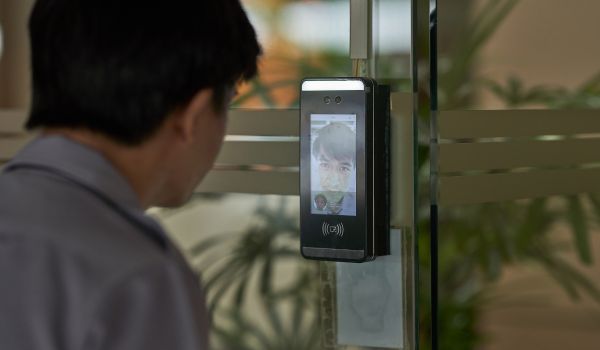
Users simply approach a reader and continue moving through the doorway without stopping to present a card or activate an application.
This frictionless experience has become increasingly important as organizations seek to improve building experiences while maintaining strong security controls.
Expanding Use Cases
Until recently, facial biometrics were largely confined to highly sensitive environments where organizations were willing to invest in specialized infrastructure. Lower hardware costs and simplified deployment have expanded those opportunities. As a result, organizations that once assumed facial biometrics were beyond their requirements or budget are beginning to reconsider where the technology can add value.
Adoption is growing across office buildings, healthcare facilities, education campuses, manufacturing sites and commercial offices. Many of these deployments are motivated as much by convenience and operational efficiency as by security requirements. For organizations that are starting to explore biometrics, everyday access control can serve as a practical entry point, allowing teams to gain experience with the technology in lower-risk settings before extending it to more sensitive areas.
This technology also complements broader identity strategies. Facial authentication can serve as a primary credential, a secondary verification factor or part of a multi-factor authentication workflow depending on organizational requirements. It can also complement existing cards, mobile credentials and PIN-based systems, allowing organizations to modernize without replacing proven access control workflows.
Security teams can apply stronger verification in higher-risk areas while preserving convenience for routine access. Many organizations begin with a small number of entrances before expanding biometric authentication as operational needs evolve.
Intelligence at the Edge
One of the most significant developments in current-generation biometric readers is the growing amount of intelligence that resides directly within the device itself. Rather than serving solely as an authentication point, today's readers perform local processing, make access decisions and support integrations directly at the edge.
By moving more processing and decision-making directly into the reader, organizations gain faster response times, lower network dependency and greater operational resilience. It also allows certain functions to continue operating even if connectivity to centralized systems is interrupted.
Edge-based processing also creates opportunities for additional functionality beyond access control. Many newer biometric devices now incorporate integrated displays that can provide instructions, alerts, visitor guidance or organizational branding. Instead of acting solely as security hardware, the reader becomes a communications touchpoint that improves the user experience at the door.
For large organizations, this capability can help reinforce messaging and branding, display visitor instructions and deliver real-time notifications without requiring separate infrastructure.
Convergence with Video Security
Modern facial biometric readers are also beginning to blur the line between access control and video surveillance. Advanced biometric readers include high-quality imaging systems capable of supporting functions beyond identity verification. In some cases, the reader's camera can simultaneously support biometric authentication while also providing video streams to broader security platforms.
This gives security teams another layer of visibility at the door.
Because access readers are installed at eye level, they often capture facial images from an angle that traditional overhead security cameras cannot. This can be particularly useful for documenting access events, investigating incidents or identifying attempts to tamper with access control equipment.
For example, an individual attempting to obscure their appearance from a ceiling-mounted camera may still be clearly visible to a reader-mounted camera positioned directly at the point of entry.
Security teams gain greater situational awareness without requiring additional dedicated surveillance infrastructure.
Privacy Remains Essential
As facial biometric adoption grows, privacy considerations remain critically important. Organizations evaluating biometric technologies must establish clear policies governing data collection, storage and usage. Users should understand how biometric information is protected and how it is being used.
Modern biometric systems increasingly incorporate privacy-by-design principles that support secure template storage, encrypted communications and compliance with applicable regulations and organizational policies.
Clear communication with users also plays an important role. Modern facial biometric systems can be designed so that personally identifiable information is not stored on the reader itself, while biometric templates remain protected and do not traverse the network during authentication. For many organizations, successful deployment depends as much on transparency and trust as it does on technical performance.
The Future of Access Control
The broader access control industry continues moving toward a future defined by mobile credentials, biometrics, artificial intelligence and increasingly unified identity management platforms. HID's latest industry research found that 45% of organizations view biometrics as a strategic priority, while 34% have already deployed biometric technologies and another 23% are planning implementation. Facial biometrics are becoming part of this larger transformation.
Lower costs, improved accuracy and simpler deployment are expanding the range of organizations that can realistically deploy facial biometrics. Organizations that once assumed facial biometrics were reserved primarily for large enterprises or high-security facilities are increasingly evaluating it for everyday access control applications.
As adoption grows, attention is shifting from technology to the practical outcomes it enables. Increasingly, the question is how facial biometrics can help organizations create safer, smarter and more seamless access experiences for the people who use their facilities every day.
This article originally appeared in the September/October 2026 issue of Campus Security Today.