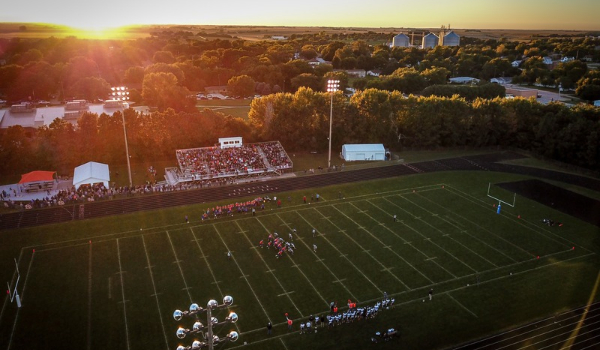
Why Friday Night Football Needs Its Own Security Plan
High school games require plans for weapons screening, crowd flow, responder coordination and security beyond the stadium gates.
- By Tom McDermott
- October 29, 2026
When people think about stadium security, major college football programs and NFL games typically come to mind. Thousands of fans, large venues and extensive security operations justify the need for crowd management and weapons screening. High school football, on the other hand, is often viewed as a smaller, more familiar community gathering. But recent incidents suggest that distinction deserves a closer look.
The 2026 high school football season was barely underway when a 17-year-old was fatally shot during a game in Bakersfield, California. Near Pittsburgh, a teenager allegedly fired a stolen handgun near a stadium entrance. In Sharpsburg, Georgia, deputies recovered a stolen firearm following a fight at a football game. And gunfire outside a stadium in Manteca, California, prompted officials to end a game early.
These incidents underscore a critical point: A venue does not need an NFL-sized crowd to face a serious security incident.
The campus plan is not the stadium plan
During the school day, districts generally know who belongs on campus, which doors should be open and how visitors enter. On game night, students mingle with parents and visiting fans who may have no connection to either school. Crowds arrive in waves, stay after dark and spread across bleachers, concessions, parking lots and nearby streets.
A district can have strong building access controls and still be unprepared for violence at a football game. The challenge is less about copying a professional venue's security budget and more about applying event-specific thinking at a scale the district can sustain.
Make screening part of the experience, not a barrier
Weapons screening is a highly effective layer of a district's approach, but equipment alone doesn’t solve the threat. Security teams should estimate attendance, peak arrival times, lane capacity and staffing before deciding how screening will work.
Modern screening systems can let spectators carry everyday items like phones and keys through security checkpoints without stopping to empty their bags or pockets. By targeting weapons rather than flagging all metal objects, these systems cut down on unnecessary alerts and help keep entry moving. Still, districts should examine detection accuracy, secondary screening requirements and whether advertised throughput rates hold up under real-world conditions like peak arrival times.
A long line outside the gate creates its own exposure. Screening plans should account for queue placement, accessible routes, weather and secondary screening. A well-designed operation doesn't need to stop entry every time the system flags something. With the right setup, a person who triggers an alert can be directed to a secondary check while the rest of the line keeps moving, keeping spectators flowing even when an item requires closer inspection. In addition, policies should be clearly communicated and applied consistently because community events depend on people feeling welcome as well as protected.
Give every responder a defined role
A high school game may bring together district security employees, contracted guards, volunteers and police. Unlike a professional venue with dedicated event operations, those people may work together only a handful of nights each season.
Brief them together before gates open. Establish who handles an alert, who performs secondary screening, who contacts law enforcement and who has authority to suspend the game. Include a backup communication plan if radios or cellular service fail.
Rehearse scenarios that reflect the site: a fight in a parking lot, an alert at a checkpoint or a sudden crowd movement after a loud noise. Training should cover de-escalation and respectful interactions alongside the practical steps for clearing an exit or requesting assistance.
The perimeter matters as much as the gate
Entry screening gets attention because it’s visible. But events in Pennsylvania, Georgia and Manteca also show why security cannot be limited to the ticket line. An incident nearby can affect people inside, even when the person involved never passes through a checkpoint.
Walk the site during game-night hours. Identify poorly lit paths, places where crowds gather, parking lot crossings and areas where exiting spectators could bottleneck. Review how the stadium connects to school buildings, sidewalks and streets.
The objective is to assign staff where observation and quick communication matter most, not to post personnel everywhere.
Use each game to improve the next
The advantage of a recurring event is the opportunity to learn. A 10-minute postgame discussion may expose a congested entrance, an unstaffed crossing or confusion about who made an announcement. Document what happened, assign a fix and check whether it worked the following week.
That approach matters for districts without the budgets or staffing of major sports venues. But with the right planning and screening technology, a high school’s game-night security plan can feel like a professional-level operation. The same weapons detection systems used in NFL stadiums and major college programs are available to high schools, closing the gap between Friday night lights and professional venues.
Friday night football will always have a local feel that no professional game can replicate, and that’s worth protecting. But familiar surroundings don’t eliminate public-event risks. With the right planning and screening technology, a district doesn’t have to choose between preserving that experience and delivering professional-level security. Both can share the same field.