Resolving Longstanding Security Issues on Campus
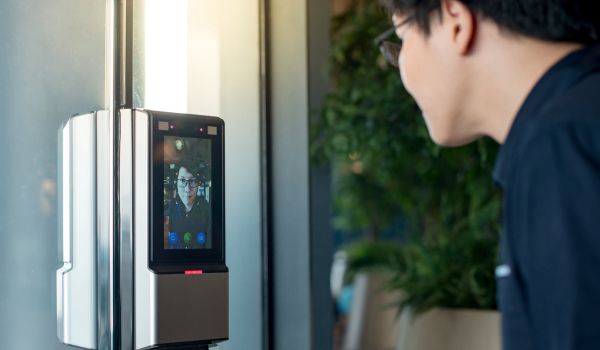
Replacing traditional physical credentials with facial authentication streamlines entry points, eliminates credential sharing, and protects sensitive campus facilities.
- By Divya Taneja
- August 03, 2026
By the busiest part of the morning, the pressure was visible at the edges of campus.
Students slowed as they approached building entrances, searching for ID cards or waiting for someone ahead to move through. At vehicle access points, a single missing credential causes traffic to back up, forcing security staff to step in and keep things moving.
From a distance it looked like routine congestion, but for the people responsible for campus safety, these moments carried a different weight.
Every delay, every workaround, every decision to wave someone through was a small tradeoff between keeping the campus traffic moving and supporting tight control over who was entering. Most days, those tradeoffs went unrecorded; nothing visible is broken, there are no alarms, and the system continues to function.
But in those seemingly insignificant, irregular moments, campuses begin to lose something less visible: awareness. Taken on their own, they may seem minor, but collectively they create conditions where security threats can go undetected.
In today’s environment, where campuses face increasing pressure to strengthen security while also supporting efficient daily operations, these security gaps are becoming harder to accept.
These patterns are becoming more common as campuses grow – with increased activity, expectations around both safety and convenience continue to rise. What on its face appears to be a throughput problem is often something deeper.
A Broader Challenge in Campus Security
Nearly every day of the year, most college campuses are in continuous motion. Thousands of students, faculty, staff, and visitors freely move between classrooms, research facilities, athletic spaces, and common areas. This openness is part of what defines the campus experience, but it’s also what makes campus security uniquely challenging and complex.
Security teams are tasked to balance visibility, control, and response across a wide range of environments. Many of the systems in place today were designed to address specific needs at a specific time. As campuses expand, these systems are reaching the limits of their intended purpose. However, when they reach their breaking point, the result isn’t always an obvious failure.
Inconsistencies begin to appear between who is allowed to enter a space and then who does, between what security teams can see and what they can act on, and between how quickly something happens and how quickly it can be understood.
Where Traditional Access Control Falls Short
Card-based systems are still the backbone of campus access control. They are familiar, widely adopted, and deeply integrated into campus operations - but they come with limitations that are easy to overlook.
A card can be lost, shared or forgotten. When that happens, access may still be granted, even if credentials are not being used as intended. From the system’s perspective, everything appears normal.
At the same time, these systems introduce friction. When credentials are forgotten or lost, entry points slow down and a bottleneck is created. While staff can keep lines moving, a delay is inevitable. These small delays can quickly build across a bustling campus.
These challenges came into focus at a large public research university, where more than 50,000 people entered the campus each day. Delays at entry points became routine and vehicle access delays created ripple effects that brought traffic to a grinding halt. Security staff were regularly roped into managing congestion rather than monitoring activity.
What looked like an operational issue began to reveal a broader concern. These bottlenecks showed that the existing flawed access control solution was not effective in ensuring that only authorized individuals were entering campus.
Two Problems, Two Approaches
As campuses take a closer look at these challenges, it becomes clear that they are not dealing with a single issue, but two distinct ones.
The first is how access is managed.
To improve consistency at entry points, some institutions are introducing face authentication as part of their access control systems. Instead of relying on physical credentials, access is verified directly as individuals approach a door or gate. This helps reduce friction while making access more consistent, particularly in high-traffic environments.
The second is how awareness is maintained across campus.
Even when access points are controlled, campuses often lack visibility into who is present in shared spaces. To address this, institutions are exploring facial recognition in a targeted way, using alert-based systems at selected locations to name persons of concern. These alerts are reviewed by trained staff to be used as part of a broader response process – not to be treated as definitive on their own.
Together, these approaches address distinct aspects of campus security. One focuses on how people enter. The other focuses on how situations are found and addressed once they unfold.
From a Single Campus to a Notable Trend
At the large public university facing daily congestion, changes began at the entry point. The institution updated access processes across more than 100 locations, covering both pedestrian and vehicle access.
As students and staff acclimated to the new system, campus officials reported a reduction in stoppages during peak periods. Without badges to lose or PINs to forget, the need for manual intervention declined quickly, and security staff could return to patrols.
The impact of facial authentication extended beyond operations; reducing reliance on physical credentials helped address inconsistencies in how access was being used. By using faces as credentials, the school has eliminated buddy-punches, card swaps and PIN sharing, meaning tighter, more reliable access control that does not require workarounds.
Similar patterns are now emerging at other institutions, prompting a broader reassessment of how access and awareness are managed across campus.
Solving Internal Access Challenges
As campuses begin to address entry points, the same pressures often appear in other environments with proportional consequences. The solution? Facial authentication to protect restricted and sensitive areas.
Athletic facilities. Student athletes work in highly visible settings, where access to restricted areas must be carefully controlled. For many schools, their athletics division can be one of the most important parts of their reputation and draw. At the same time, movement in and throughout these facilities needs to remain fluid, especially during games and other events. Facial authentication can help keep players safe, team secrets and equipment secured, and even make temporary access for visiting teams fast and easy to manage.
Laboratories and research spaces. Research environments often have hazardous materials, sensitive work and expensive equipment. Access must be tightly controlled, leaving no margin for shared credentials. Badges and PINs can leave security gaps that facial authentication easily solves. For the most sensitive areas, multifactor authentication can be implemented through face + card or face + PIN.
Testing environments. Testing centers require an elevated level of accuracy and control. Ensuring the correct student enters the correct space must be done efficiently, often under time pressure. PINs and badges alone only confirm that the correct credentials were used, without verifying the identity of the person using them. Facial authentication allows testing centers to be confident that the students being evaluated are the ones who will receive the grades.
Post-incident Investigations
After an incident, security teams are often asked to figure out where a suspect was last seen and how they moved through campus. This process typically involves reviewing large volumes of video without a clear starting point. Without efficient tools, investigations can be slow and resource intensive.
Some institutions are implementing cameras enabled with facial recognition to improve how information is surfaced and speed investigations. With less time spent on investigations, security teams can focus on responding faster and more accurately.
What Comes Next?
Most institutions begin their journey by solving a specific challenge, rather than a full system overhaul. This might be an entry bottleneck, a high-risk facility, or an entryway where staff are regularly pulled in for manual intervention. From there, changes are assessed and expanded over time.
What begins as an operational improvement can often lead to broader discussions about consistency, visibility and how campus security is managed overall. Decisions about monitoring, alerting and access control require clear policies, defined responsibilities and alignment with campus expectations. Improving how a campus manages movement and awareness does not end the conversation, it starts it.
This article originally appeared in the July August 2026 issue of Campus Security Today.