The Inside-Out Defense: A Roadmap For Layered K-12 Security
The PASS 7th Edition Guidelines provide a tiered technical roadmap that shifts the focus from perimeter defense to protecting the classroom heart.
For years, the prevailing wisdom in K-12 security followed a "moat-and-castle" philosophy — an outside-in strategy that prioritized perimeter defense. But as we evaluate the evolution of school safety leading practices, there remains a compelling statistical reality.
The 2015 Final Report of the Sandy Hook Advisory Commission states, “There has never been an event in which an active shooter breached a locked classroom door.”
This finding has remained consistent in the years following the Sandy Hook tragedy. This data point is foundational to an inside-out layered approach to school security, prioritizing resources where the highest concentration of life — and risk — exists.
By securing the classroom first, schools can prioritize cost-effective life safety measures where they matter most. To help schools begin navigating this strategic shift, the Partner Alliance for Safer Schools (PASS) has released its 7th Edition Safety and Security Guidelines. This latest edition serves as a technical roadmap, moving the conversation beyond standalone solutions toward a tiered, converged defense that helps enable technology and policies to work as a force multiplier for those we are sworn to protect.
The PASS Guidelines follow a tiered approach, starting with Tier One as a foundational baseline for all schools and progressing towards Tier Four for the most comprehensive approach. This framework allows administrators to prioritize essential safety measures first and scale their efforts as funding, culture, building layouts and unique needs dictate.
The Classroom as the Heart of the Defense
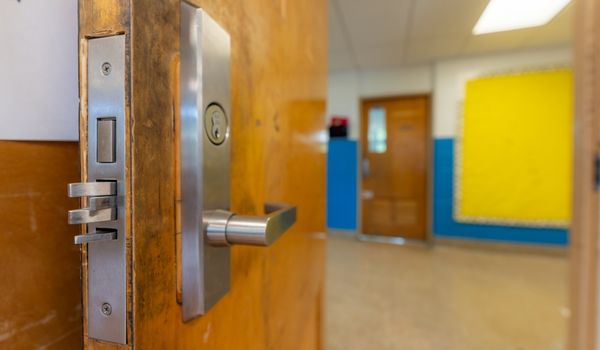
If the classroom is the heart of school safety, then the door is its primary valve. However, navigating the technical breadth of hardware options can be daunting.
The PASS 7th Edition simplifies this by breaking interior classroom locks into five distinct categories, allowing security professionals to move beyond basic hardware conversations.
Categories 1 and 2 represent traditional mechanical hardware.
Category 1, the "blank inside" style, is generally no longer recommended because it requires a teacher to physically step into the hallway to lock the door. Category 3, or the "Inside Activator," introduces a thumb-turn or push-button lock. This is a key consideration for schools, as it uses "gross motor skills;" skills we can more reliably count on when adrenaline and cortisol surge.
As we move into Tiers 3 and 4, we see the emergence of Categories 4 and 5: Electronic Hybrids. These solutions allow for remote, centralized lockdown while still providing local activation. The technical advantage here is twofold: it eliminates the temptation of convenience with propping doors open with magnets or wedges, and it provides an audit trail of which doors are secured and accessed.
For locks in Categories 2 through 5, it is recommended that a clear interior "Locked/Unlocked" status indicator be visible. This eliminates the need for occupants to approach the door to verify security, allowing them to confirm from anywhere in the room.
A Professional Warning on Barricade Devices
The PASS Guidelines expressly indicate that barricade devices offer no benefit to code-compliant locks. Aftermarket secondary locking devices often violate ADA requirements for one-hand operation and NFPA 101 standards for single-motion egress.
In prioritizing life safety, we must secure the room without compromising the ability to exit. Barricade devices can trap occupants during fire or medical emergencies and, in a worst-case scenario, can be used by a perpetrator to block first-responder access.
The Building Perimeter as the Primary Filter
As we move away from the classroom, we reach the building's perimeter layer, our primary filter for traffic. A secured vestibule and single point of entry remain the architectural gold standard when it comes to building perimeter access control, as it provides visibility of all the comings and goings, from students and staff to deliveries and visitors, and access control plays a key role in managing this layer. The PASS Guidelines provide a roadmap in securing the exterior at each tier.
Tier 1: Establishing Baseline. At the foundational level, every exterior door must be secured with a working mechanical or electronic lock compliant with local building codes and the ADA. A key technical requirement is the use of a Patented/Restricted Key System. This prevents unauthorized key duplication, a basic but often overlooked security function.
If exit devices feature "dogging" (holding the door unlocked), they must use a cylinder-type mechanism with a visual indicator so staff can verify the door's status at a glance. Tertiary openings should be exit-only with no outside trim and should not have dogging mechanisms.
Tier 2: Expanding Control. Moving to Tier 2, it is recommended that schools implement electronic access control (EAC) on all primary and secondary entrances. This allows the district to limit the distribution of physical keys and enhances the ability to audit who accessed a specific opening and when.
Remote door release mechanisms should be integrated here, utilizing electric latch retraction to ensure that visitor entry points can be managed without staff leaving their secure stations.
Tier 3: Responder Integration and Total Coverage. The third tier focuses on interoperability with emergency services, introducing mobile credentials for emergency responders. When used with a standardized door numbering system, these credentials allow law enforcement to enter the building through the door closest to the emergency event.
The Campus Perimeter as Territorial Reinforcement
The outermost layer of the school’s campus is the campus exterior perimeter, where we can apply the principles of Crime Prevention Through Environmental Design (CPTED). The goal here is "territorial reinforcement,“ using the environment to designate school property and deter trespassing or criminal activity.
“Natural surveillance” is key: managing landscaping helps to maintain clear sightlines from the main office to the parking lot. If an unauthorized individual is loitering, that person should be visible before reaching the building's perimeter.
Landscaping also helps with territorial reinforcement. Paths, trees, shrubs and other landscaping create natural boundaries and designate areas for use or movement throughout campus.
Strategically placed lighting is an excellent method for deterrence and safety. In highly lit areas, unauthorized activity is more easily recognized and less likely to occur. Properly angled lighting also allows better visibility for surveillance cameras.
Operationalizing the Layers: Standardizing Procedures and Drills
Hardware is essential, but it is more effective when supported by people and policy. While active shooter simulations provide valuable skill training for staff and students, standardized lockdown drills as defined by the National Association of School Resource Officers (NASRO) and the National Association of School Psychologists (NASP) remain essential.
These drills should be educational, clearly communicated ahead of time, and focused on the technical mastery of skills that support the layers we’ve built. School leaders should understand the purpose of all safety procedures — including lockdown, active shooter drills, severe weather and fire drills — who to involve, and how they complement the tools they have and the threats they may face.
The Tiered Journey
Security is not a destination; it is a journey along a continuum. Whether your district is at Tier 1, establishing a baseline of locked doors and basic CPTED, or Tier 4, with a fully networked, unified defense, the philosophy remains the same.
By adopting an "Inside-Out" approach, we work to ensure that our resources are best positioned to protect the heart of the school: the students and teachers inside the classroom. Technology will continue to evolve, but the goal remains constant: providing a safe environment where learning is the number one priority.
This article originally appeared in the May June 2026 issue of Campus Security Today.