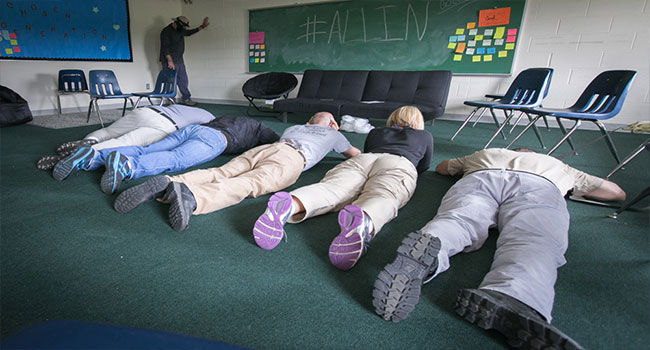
Teachers’ Unions Say Active Shooter Drills Need Reform to Protect Student Mental Health
The AFT and NEA have released a paper stating that they do not recommend shooter drills and issued six key guidelines for districts that continue to conduct the drills.
- By Haley Samsel
- March 05, 2020
After witnessing the traumatic impact that active shooter drills can have on students, particularly young children, two major teachers’ unions have joined with the advocacy group Everytown For Gun Safety to ask school districts and states to rethink how they conduct these drills, if they continue them at all.
Active shooter drills have become a regular, if not required, part of the American education system, particularly in the wake of mass shootings that have claimed the lives of dozens of students and staff in recent years. Approximately 95 percent of public schools conduct some form of the drills, also called lockdown drills, on a regular basis.
The American Federation of Teachers and the National Education Association, which have millions of members across the U.S., have now published a white paper stating that they do not recommend the drills and that they could have a very negative impact on students’ psychological health.
The report notes that the drills are required in at least 40 states, despite what the associations describe as “scant evidence that they are effective at preventing deaths” in school shootings.
“Given growing concern among parents, students, educators, and medical professionals about the impact that active shooter drills can have on student development, Everytown, AFT, and NEA do not recommend these drills for students and believe schools should carefully consider these impacts before conducting live drills that involve students and educators,” the report reads.
Lily Eskelsen García, the president of the National Education Association, told The Guardian that there is a difference between talking to students about where to hide in an emergency and having dramatic, graphic drills that simulate terrifying events.
“You have kids wetting their pants, you have kids crying, you have teachers crying and you have everyone saying, ‘this is it – I’m going to die’,” Eskelsen García said. “And when it’s over, it’s like – just kidding!”
The unions were critical of the campus security companies that provide active shooter drill services, with Eskelsen García stating that the companies are “preying on the anguish of parents and school staff” and their desperation.
But Jean-Paul Guilbault, the CEO of the Alice Training Institute, one of the top active shooter training companies, pushed back on that narrative, noting that children are already living in a frightening reality. Drills should be age-appropriate and not traumatize the students, he said. “But when that alarm goes off, when the panic button is pushed, people should know how to secure a room,” Guilbault told The Guardian.
The AFT, NEA and Everytown suggest that schools that continue to conduct drills should start ensuring that they follow six key rules, including not using simulations that mimic a real incident and announcing the drills to parents, students and educators prior to their occurrence.
The drill’s content should be “age and developmentally appropriate” that is developed with mental health professionals, and ensures that there are “trauma-informed” approaches to help students who feel psychological effects from the drill. Lastly, schools should track data about the “efficacy” or effectiveness of the drills.
“If schools decide to adopt these drills, they must be part of a comprehensive safety plan that includes measures to prevent active shooter incidents from happening in the first place,” the report, released on Everytown’s research platform, reads. Those measures should include threat assessment programs, mental health resources, collaboration with law enforcement and community advocacy, it adds.
About the Author
Haley Samsel is an Associate Content Editor for the Infrastructure Solutions Group at 1105 Media.