The Next Evolution of Campus Security
- By Matt Jones
- May 23, 2022
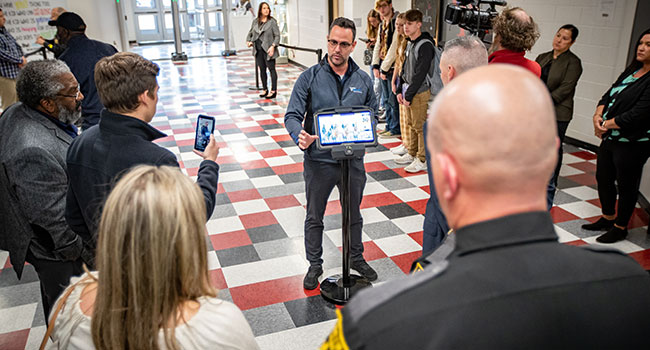
Safety and security at one West Virginia school district has officially evolved. Fayette County Schools in Fayetteville, WV, recently received and installed three weapons screenings systems from Evolv Technology during the inaugural round of the company’s GiveEvolv grant program.
GiveEvolv launched in September 2021 with the mission of “providing need-based, free-of-charge donations of Evolv weapons screening systems to schools that would not otherwise be able to afford them,” according to the initial press release.
The idea began when NewHold Investment Corp. partnered with Evolv to take the company public in July 2021, explained Kevin Charlton. Charlton serves as the CEO of NewHold, as well as a member of both the board of directors of Evolv and the advisory board of GiveEvolv. As part of that transaction, Charlton said, NewHold contributed equity—shares in the parent company—to create GiveEvolv.
“So, we gathered applications from schools across the country, and in total candor, we got fewer than we expected,” he said. “We were surprised by the number of technologies that these schools were exposed to and the challenges they were having sifting through those possibilities. And so, I think we concluded that people didn’t understand—or, well, we were failing to tell the story effectively—of how Evolv is different than other technologies.”
Meanwhile, in West Virginia, representatives of Fayette County Schools were on the hunt for an upgrade to the district’s metal detection systems. District network specialist Mo Shrewsberry happened to be visiting a large amusement park and noticed the functionalities of the park’s security system—courtesy of Evolv. Fayette County Schools Superintendent Gary Hough said that Shrewsberry came into his office and asked if Hough would agree to bring in one of the systems to test its compatibility within the school system.
"I was actually heading to that same venue about a week later,” said Hough. “I took a look at it, came back, and said, 'Yeah, let's give this a run. Let's see what we can do with it.' So that's where we got our opportunity to at least discuss it. And then, when we brought one in for a test, we decided this is definitely what we need to look at."
The district purchased and installed its first Evolv weapons detection system in November 2021. Hough said that the district didn’t have the funds at the time for a larger-scale purchase, but the plan was to put the resources into an upcoming levy within the next few years. Then, Hough said, they came across the opportunity to participate in GiveEvolv.
“Initially, when we started developing the criteria for GiveEvolv, one of the criteria was to focus on either schools that had had an incident, or schools in an area that had particularly high levels of gun violence,” Charlton said. “That faded, because what we realized pretty quickly was that the incidents that have occurred are not particularly tied to those criteria. And so, that was one. And two was that it doesn’t matter where you go—this issue is very central in the minds of any administrator, at any school, anywhere.”
Evolv Express weapons detection systems allow crowds to pass through at normal speed. Students don’t need to empty their pockets, remove their bags, or stop for any kind of additional screening unless the system flags them. The system can screen 3,600 people per hour, and its flexible deployment options allow for easy portability and use either indoors or outdoors. It uses artificial intelligence, security ecosystem integrations and venue analytics to ensure safe and accurate threat detection with as little hassle—and as few false flags—as possible.
“When we realized that awareness among school districts of the distinctive nature of the Evolv technology was lower than we anticipated, that elevated—okay, well, we need somebody who can help tell the story to their peers. And we felt that that really was the driving criteria,” said Charlton.
In March 2022, Fayette County Schools was officially named the first recipient of the GiveEvolv grant program. It received three Evolv Express weapons screening systems to be installed at Oak Hill High School, Oak Hill Middle School and Fayetteville PK–8.
“Throughout all Fayette County Schools, we are committed to fostering a learning environment where everybody feels included, safe and respected,” said Hough in a press release at the time of the announcement. “We proactively pursued the GiveEvolv program so that our students, staff, their families, and everybody who enters our buildings comes into a safe environment focused on the education and development of our next generation.”
Following a brief installation process, feedback from the school community at large has been overwhelmingly positive, said Sherri Kidd. Kidd serves as a special education teacher for Fayette County Schools, and she’s also on the security team that handles the technology.
“It's been very positive,” said Kidd. “We see many of the students—and the teachers, and the parents—all have a positive attitude towards it. There's not been a disruption to the flow of students coming through; nobody's late for class. The students know the routine. They all seem to—I feel like they feel safer when they come through. Like I said, they know the routine. They'll have their computers out because they'll need to check the computers. They go through, if they detect something, they'll just walk over to the table. It seems to be a positive impact on our school.”
Hough agreed that the new installation is a significant improvement over the “massive process” that was the school’s old metal detection system. He relayed an anecdote from the old days in which he got a phone call from a high-school principal about a weapons threat. “We had, oh, at the time, probably about 1,200 students in the building, and we had two metal detectors,” he recalled. “We had children lined up…it took about two hours to get the students into school during the day. It was just a very, very difficult process.”
Charlton also said that feedback from the district has been positive. Fayette used to employ its metal detectors on a sporadic basis. He said that in conversation with students at the school, his biggest takeaway was the two downsides of that system. First is the obvious inconvenience of such an arduous process. “They said, ‘When the metal detector’s there, it’s a huge pain because I missed first period, and I have to leave my backpack behind ‘cause they don’t have time to wand all of them, and blah blah blah.’ All things we’d heard and we knew. So far, kind of as expected,” he said.
“And then, they said, ‘But there’s also a second reason we hate the metal detector, because the next day, we feel really at risk. Because anybody who wants to bring a weapon is going to bring it the day after the metal detector was in, because they know they’re not going to do it two days in a row.’
“And then,” according to Charlton, “they said, ‘And the other comforting thing about Evolv is it’s everybody, every day.’ And so, I said, ‘All right, how many weapons do you think it’s going to find?’ And the kid goes, ‘None.’ And I was like, ‘Oh. All right. Then what value are we bringing?’ And he said, ‘Because no one’s gonna try. They know it’s gonna get caught, so why would you try?’”
Future rounds of the GiveEvolv grant program will focus on distributing the technology as widely as possible. Criteria for selection to receive the grant include economic need, “which is a big one,” Charlton said. “We’re looking for schools that can’t otherwise afford it. We’re looking for schools that are geographically diverse and kind of—we like diversity in terms of rural, suburban, urban, to show that this is applicable in any school. I think we’ll make exceptions if schools have been through a recent incident. Those kids need peace of mind, and that’ll move to the top of the pile. But we want to be cautious about imposing ourselves when schools are dealing with the aftermath of that tragedy. That will be strictly inbound.”
Evolv hasn’t set solid dates for the next round of grants, but Charlton did say that it would be before the beginning of the 2022–23 academic year. He confirmed that any submissions received during June 2022 would be well within eligibility for the next grant. Further information and the application form are available on the Evolv website.
“I’m very thankful that they chose here in Fayette County to receive that gift,” said Hough. “Very thankful. Our teachers—people like Sherri here—have done a wonderful job of being a great team member and understanding what we have to do to achieve the safety and security of our students.”
This article originally appeared in the May / June 2022 issue of Campus Security Today.