UVA Nursing Students Host “Stop the Bleed” Course at High School

UVA Nursing Students Host “Stop the Bleed” Course at High School

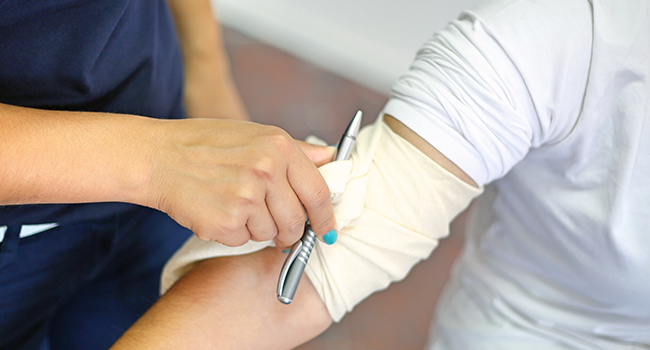
Louisa County High School held a “Stop the Bleed” course, where University of Virginia nursing students trained students, faculty and staff in how to handle a life-threatening injury.

Louisa County High School held a “Stop the Bleed” course on March 21, where University of Virginia nursing students trained students, faculty and staff in how to handle a life-threatening injury.

“You really, truly never know when you're gonna be the one who needs to make that difference,” said Ryan Thomas, a third-year University of Virginia nursing student. “The [Stop the Bleed] course was created after the Sandy Hook massacre and it was created to empower people to respond to life-threatening bleeds in that like 3 to 5-minute time frame when it really counts.”

If a person were to lose just half a gallon of blood in that 3- to 5-minute time frame, they would die. Attendees of the Stop the Bleed training at the high school learned how to stop that blood loss by using a tourniquet or packing a wound.

Thomas was the one to introduce the idea of holding the Stop the Bleed course.

“My first day of clinical here, we had a lockdown drill and so I asked a lot of questions and got into a really good conversation about how our preparation and response is like totally just to lock ourselves in a room, and we don't ever address like what to do next if something were to happen,” Thomas said.

Teachers, school resource officers and students in the certified nursing assistant classes are now prepared to respond to a worst-case scenario.

 “It can help anybody, because things can happen in society today anywhere anytime,” said Amaya Green, a senior certified nursing assistant. “You know you could be at home, you could be at the mall, you could be at the movie theater you know school. Things aren’t quite as safe as you think they are and you never see what’s coming so it’s important to be prepared.”

In addition to teaching the Stop the Bleed course, Thomas was able to secure a grant to provide the high school with 8 bleeding control kits containing gauze, tourniquets and other supplies.

About the Author

Jessica Davis is the Associate Content Editor for 1105 Media.

Featured

  • Electrified Latch Retraction Locks Key Benefits for Retrofits

    Building owners and facility managers increasingly rely on electrified hardware to enhance security while meeting accessibility standards. Among these technologies, electrified or motorized latch retraction locks are especially effective for retrofit projects where existing door and frame conditions complicate upgrades. Latch retraction capable locks combine security, accessibility and code compliance benefits, making them ideal for retrofitting fire-rated and non-rated openings in schools, healthcare facilities, commercial buildings and more. Read Now

  • How Cloud Security Solutions Are Transforming Campus Safety

    Campus administrators today face a challenging mandate: deliver stronger security across their facilities while working within tighter budget constraints. From school districts focused on student safety to hospitals protecting patients and staff, the question remains the same: how do you build security infrastructure that evolves with your needs without requiring massive capital investments? Read Now

  • Rethinking Campus Security From the Inside

    For decades, campus security strategies focused on keeping threats outside school walls. But since the tragedy at Columbine High School, data has shown that many attacks begin inside the building, often in classrooms and corridors. This shift has prompted schools to rethink security from the inside and place greater emphasis on interior elements such as classroom doors. This shift is evidenced by a new generation of classroom door systems engineered to delay inside intruders and an ASTM standard that raises the bar on how these systems must be designed to defend against attack. Read Now

  • AI in Security: Advancing Campus Safety and Considerations for Implementing

    Artificial intelligence (AI) continues to capture attention across every sector, and the physical security industry is no exception. Once seen as experimental, AI-enabled analytics now underpin how organizations monitor environments, detect threats, and make decisions. What was once futuristic is now a practical necessity for safety professionals managing growing volumes of data, tighter resources, and increasing expectations for faster, more accurate responses. Read Now