Nebraskan High School Installs Security Doors

Nebraskan High School Installs Security Doors

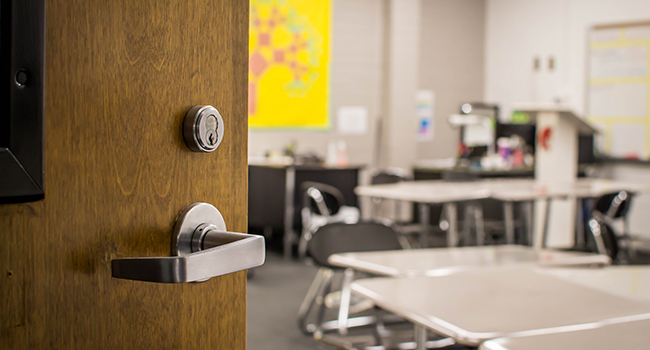
“These new doors are heavy, they’re solid, they’re fire-rated and the windows are security glass,” Principal Jordan Engle said.

Grand Island Central Catholic School has installed 25 new security doors to improve safety on campus.

According to Principal Jordan Engle, the school replaced every classroom door, a few doors that “were in pretty bad shape,” a locker room door and a door to the school’s auditorium.

Engle told The Grand Island Independent that the new doors replaced the original doors installed when the GICC campus was built in the late 1950s. Those doors were very lightweight and were not fire resistant.

“These new doors are heavy, they’re solid, they’re fire-rated and the windows are security glass,” Engle said. “The narrower window is what you would typically see in a school or a hospital. The reason being is that if we shut that door, you can always see out, but it is harder to see in because of the narrower point of reference.”

The new doors also feature metal kickplates at the bottom. Engle said the kickplates will help the doors stay in good shape as time goes on, since doors are sometimes opened with a foot rather than a hand.

“The knobs on these doors are for safety as well,” Engle said. “They do not have an unlock mode, so you only have a key to entry to the classrooms, which is a very big safety measure that a lot of schools are taking right now. This is a big deal for us in terms of school safety.”

The total cost of the new security doors was about $25,000, according to Engle. The doors were purchased using some of the funds raised by the GICC Development Foundation during its 2018 Go Big Give campaign.

GICC Development Foundation Executive Director Brenda Branstiter said the organization is glad some of its funds raised went toward the installation of the new doors.

“I think this is great because our student safety is very important,” she said. “It was definitely needed, so it was great to put that first.”

About the Author

Jessica Davis is the Associate Content Editor for 1105 Media.

Featured

  • Electrified Latch Retraction Locks Key Benefits for Retrofits

    Building owners and facility managers increasingly rely on electrified hardware to enhance security while meeting accessibility standards. Among these technologies, electrified or motorized latch retraction locks are especially effective for retrofit projects where existing door and frame conditions complicate upgrades. Latch retraction capable locks combine security, accessibility and code compliance benefits, making them ideal for retrofitting fire-rated and non-rated openings in schools, healthcare facilities, commercial buildings and more. Read Now

  • How Cloud Security Solutions Are Transforming Campus Safety

    Campus administrators today face a challenging mandate: deliver stronger security across their facilities while working within tighter budget constraints. From school districts focused on student safety to hospitals protecting patients and staff, the question remains the same: how do you build security infrastructure that evolves with your needs without requiring massive capital investments? Read Now

  • Rethinking Campus Security From the Inside

    For decades, campus security strategies focused on keeping threats outside school walls. But since the tragedy at Columbine High School, data has shown that many attacks begin inside the building, often in classrooms and corridors. This shift has prompted schools to rethink security from the inside and place greater emphasis on interior elements such as classroom doors. This shift is evidenced by a new generation of classroom door systems engineered to delay inside intruders and an ASTM standard that raises the bar on how these systems must be designed to defend against attack. Read Now

  • AI in Security: Advancing Campus Safety and Considerations for Implementing

    Artificial intelligence (AI) continues to capture attention across every sector, and the physical security industry is no exception. Once seen as experimental, AI-enabled analytics now underpin how organizations monitor environments, detect threats, and make decisions. What was once futuristic is now a practical necessity for safety professionals managing growing volumes of data, tighter resources, and increasing expectations for faster, more accurate responses. Read Now