Unique Challenges
560-acre downtown campus invests in unified security platform to heighten campus security over time
- By Andrew Elvish
- April 01, 2016
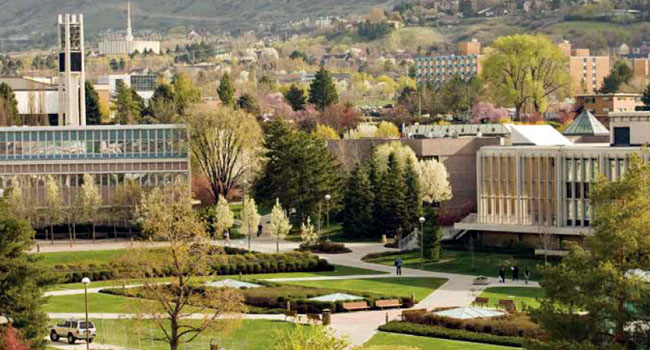
Founded by the president of The Church of Jesus
Christ of Latter-day Saints (LDS) Church in 1875,
Brigham Young University (BYU) has evolved into
the third largest privately-owned university in
the United States. The campus grew from a single
building to 320 buildings spread throughout
the downtown core of Provo, Utah.
With almost 33,000 students and just under 5,000 academic and
administrative staff, BYU takes its responsibility to provide a secure
environment for students, staff and visitors very seriously. The campus
also offers 60 parking lots totaling around 17,000 spaces, and distributes
65,000 parking permits each semester.
“Because we are sitting in the middle of a city, we have 90,000 vehicles
passing through our campus every day,” said Steve Goodman, the
technology architect and manager of the communications center for
BYU’s chartered police department,” This creates unique challenges for
our team. We are very passionate about securing our campus, but at
the same time, we don’t want our security initiatives to detract from
what we have worked hard to build here on campus—that is an open
and vibrant environment that promotes higher learning.”
Investment in Parking Leads
to Better Campus Security
The first step for BYU was to address vehicle security and parking.
When electronic barriers on gated parking lots began to fail, and sticker
permit costs kept rising, BYU sought to upgrade its system to the
latest advancement in parking technology by implementing an automatic
license plate recognition system (ALPR). After researching
ALPR solutions, Goodman and the team at BYU chose Genetec AutoVu,
the license plate recognition system of Security Center. The
Genetec security platform unifies video surveillance, access control,
ALPR and other third-party systems such as intrusion detection, in
one intuitive solution.
“We didn’t know it at the time, but our investment in the ALPR
system was the start of a fully integrated security system that has
grown over time,” Goodman said. “Security Center allows us to add
components as we make decisions about improving campus security.”
Four years after the successful implementation of the ALPR system,
BYU decided to expand the use of the software platform and upgrade
its outdated analog video surveillance system to IP. The university
slowly began integrating all analog cameras with Genetec Omnicast,
the video surveillance system of Security Center, and added new IP
cameras where needed. Omnicast software supports a long list of video
devices, so transition was seamless.
Security Center Platform Allows BYU
to Roll-out Additional Functionalities
The most notable advantage for BYU has been the ease of system unification
offered by the platform.
“With Security Center, we are expanding our platform in a way that
our operators will have everything they need at their fingertips to
ensure the fastest and safest response to any emergency on campus,”
Goodman said. “Our vision is to enable operators to receive emergency
calls, view live video feeds from nearby cameras, lock or unlock
doors and find the nearest officer on the ground. And all of this is possible
from the map interface.”
Alongside video surveillance and ALPR, BYU used a software plugin
within Security Center to incorporate its existing third-party
access control system. More than 200 police radios with GPS tracking
are also being integrated with the unified platform and linked to Plan
Manager, the map-based interface of Security Center. This feature simplifies
the operator’s job when trying to dispatch the closest in-field
officer to respond to a call or incident.
“Being a university campus, we have access to talented software
developers, and so the robustness and openness of the software development
kit allows us to easily customize the platform,” Goodman said.
“Rather than having an external PSIM vendor try to anticipate our
needs, the Security Center platform has become the more affordable
and autonomous option for our team.”
The BYU team is currently working on a custom task within Security
Center which will act as a central dashboard for all incidents on
campus. In addition to video surveillance, access control, ALPR, and
radios, BYU’s computer assisted dispatch (CAD) system and Cisco VoIP phone system will all be pulled into the custom dashboard in
Security Center.
Security Center Heightens
Response Efficiency on Campus
BYU operators receive all notifications and alarms from a central command
post on campus. From there, they are able to dispatch guards
and police officers to handle incidents. BYU has implemented the
Security Center Mobile feature so that responding officers can use
their phones to access video prior to reaching the scene.
Other guards are assigned to manage local command posts which are
positioned throughout campus buildings such as museums, libraries, the
IT data center, motion picture studio, the broadcast center and more.
BYU was able to use the highly-granular system user privileges within
Security Center to ensure that the guards only have access to the systems
and devices for their assigned site. Hundreds of system users, including
faculty deans and other administrative staff, have also been provided
limited access to the system, in accordance with their roles.
Setting Sights on Long-Term
Investment in Security Center
For BYU, this software platform is a long-term investment. Plans to
add more devices and functionality to the unified platform are underway,
including the trial of a new emergency call station with an AXIS
video camera and Session Initiation Protocol (SIP) call button. Other
future plans include extending the system to remote campus sites in
Washington, D.C. and possibly elsewhere in the world using the Federation
feature.
“The scalability, flexibility and openness of Security Center has
been powerful, and we are realizing greater benefits as we continue
to leverage more features within the platform,” Goodman said. “Having
all of our systems come together under the unified platform helps
our team find information much quicker which
allows us to respond faster. The most beneficial
aspect of our security system is that we’re able to
remain discreet and provide a safe environment
centered on learning.”
This article originally appeared in the April 2016 issue of Campus Security Today.