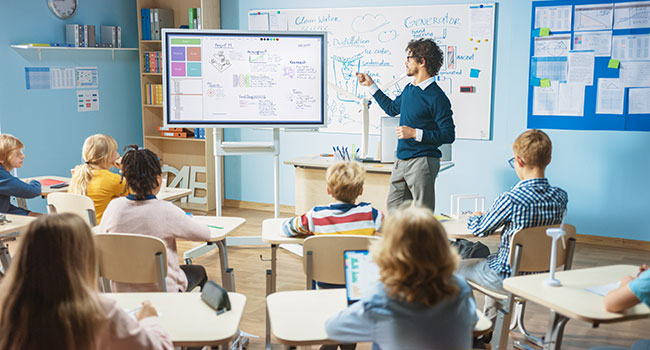
Utilize Technology to Create Interactive and Collaborative Learning Environments
- By Darryl Krall
- May 23, 2022
Today’s learning environments are radically different than those of last year and require flexible and interactive technology for adapting campus spaces to new ways of learning. Over the past two years, professors have evolved curriculums, students have adapted to hybrid and online learning, and higher education institutions have implemented technology that supported and enhanced digital and hybrid classroom settings. As we approach the end of another school year, these methods have become an integral part of the new learning experience with many higher education institutions maintaining a hybrid or online learning option for students in addition to traditional in-person classes.
Regardless of whether classes are remote, in-person or hybrid, it is critical that each learning space is well thought-out with new modalities in mind to ensure students are engaged and feel fulfilled after each lesson. From projectors and professional displays to pan-tilt-zoom (PTZ) cameras and digital audio, these solutions offer faculty and students concrete and authentic ways to connect with the subject matter, enables lessons to become more interactive rather than passive, and allows students the opportunity to revisit content at their leisure.
In 2015, a Carnegie Mellon University study found that interactive and engaging activities were six times more likely to help students learn. The findings still ring true today, though many classrooms still have not taken full advantage of the tools available to help develop engaging learning environments that improve students’ learning achievements.
Creating Better Learning Environments
AV technology helps to improve and enhance learning successes by helping to sharpen critical thinking skills, develop creative problem solving and build the ability to work cooperatively in teams through the interactive and collaborative settings it provides the classroom. The key to creating successful learning environments is to ensure the spaces inspire and allow students to engage with the content. To maximize learning and productivity, institutions should utilize easy-to-use, reliable and flexible technology that creates a collaborative learning environment regardless of the location of the student or educator.
Bright visuals in well-lit rooms with minimal noise are essential to student success. Since classrooms require reliable, consistent operation, displays and projectors that offer quiet and maintenance-free operation in addition to high-brightness and vivid colors create more engaging presentations for lectures. Incorporating projectors with an option for ultra-short throw lenses enables students and educators to approach the screen with minimal shadows, allowing learners to easily view the content without distractions.
In addition to creating engaging lectures, AV technology also empowers students to increase their understanding of the course material by revisiting the lectures through the deployment of professional PTZ cameras. By integrating PTZ cameras that support automated lecture capture software with high-precision tracking, motion detection, facial recognition and new body detection powered by deep learning algorithms, higher education institutions can provide high-quality recorded content for students that mimics the in-class experience. Lastly, audio technology is critical in learning environments, especially in scenarios where masks are required. Pro audio solutions such as digital wireless microphone systems deliver excellent speech clarity and low latency making it ideal for voice life applications for hybrid experiences.
Utilize Research and Technology to Improve Learning Outcomes
To increase learning productivity and student achievement, higher education institutions should leverage research-driven online teaching strategies to measurably accelerate student learning within in-person, online and hybrid settings. By pairing those strategies, protocols and resources with professional AV technology, educators have the opportunity to judge effectiveness of learning while transforming classroom conversations from monologues to dialogues in academia. From the student perspective, this new modality of teaching allows students to utilize the best of both worlds and develop new skills as they enter the workforce.
The interactive learning settings that AV technology creates teach students how to collaborate and work successfully in groups to solve problems and find solutions, a necessary skill as workplaces build more team-based venues. These solutions also help to sharpen critical thinking skills, which are fundamental in developing analytic reasoning, by increasing the accessibility of content and creating multiple ways for students to apply the knowledge. Incorporating AV technology efficiently into lessons can also teach students how to make decisions by allowing them to approach an open-ended question with imagination and logic. For example, immersive visuals can transport the class to a remote location for a real-life experience with geo-structural mapping or provide a specific simulation which allows the student to experience a potential real-life situation. To round it out, PTZ camera technology can then connect a classroom with remote students to bring them into the lesson and maintain a collaborative setting in a hybrid and digital classroom.
Combining AV technology with research-based learning strategies can set students up for prolonged success through increased productivity and achievement. AV technology enhances learning environments for students and can expand even further, revolutionizing the learning process when integrated into the curriculum. Today’s college students are more technically advanced than ever before, and many agree that the driver for technology and digital pedagogy will continue to grow in the future.
This article originally appeared in the May / June 2022 issue of Campus Security Today.