Georgia Southern Ensures Swift Secure Access At Recreation Center
Authorized access for thousands of daily users using an integrated solution
- By Jessica Davis
- April 01, 2018
Georgia Southern University was looking for a way to
ensure the safety of thousands of daily users at their
state-of-the-art Recreation Activity Center (RAC) by
making sure only members of the facility were able to
gain access to the building.
One key challenge for the installation was to allow for very fast
verification of members while implementing a robust basic turnstile
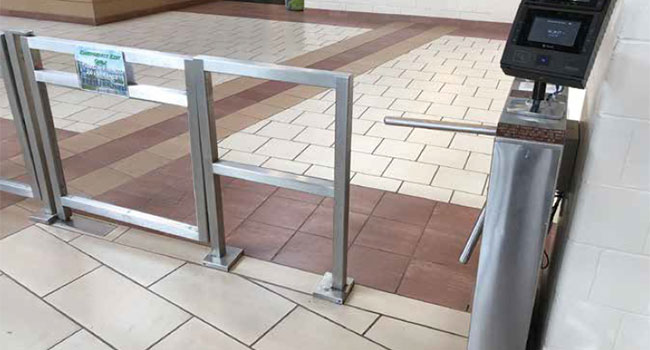
for simple entry control. A Boon Edam Trilock 60 tripod turnstile
met the need, and was integrated with an Iris ID IrisAccess
solution to minimize entry delays and complexity for students, faculty
and staff.
EXPANDING NEEDS
The RAC at Georgia Southern serves as the center of campus life, welcoming
more than 5,000 students each day. Originally opened in 1998
with 80,000 square feet, the facility was expanded in 2006 to its present
size of 215,000 square feet. The expansion achieved LEED certification,
the first building to do so at Georgia Southern, which reflected the
university’s culture of sustainability. Among the many amenities at the
RAC are an aquatics center with a 25-meter swimming pool, eight
indoor basketball courts, group fitness studios, a rock climbing wall
and an 18,000-square-foot fitness center.
The newly renovated RAC deployed waist-high turnstiles and gates
as a means to control access for the increased number of visitors each
day. By design, tripod turnstiles can be activated by an access control
system such as a card reader, biometric device or external control
panel. The access control system can be integrated directly into the
turnstile or in a separate pedestal, reception or security desk. Once the
user has been authorized to pass, the tripod mechanism will unlock
allowing the user to push through.
The RAC installed the Boon Edam Trilock 60 Medium Capacity
Tripod Turnstile, which is easily capable of handling high volume and
abusive conditions. The turnstile’s design makes it simple to construct
a multiple lane set-up.
INTEGRATING THE LATEST TECHNOLOGY
In 2006, the turnstiles were paired with fingerprint scanning technology
to confirm the identity of each member. But in 2014, when the Iris
ID IrisAccess solution was paired with tripod turnstiles at two dining
centers on campus, the RAC facility managers decided to investigate
integrating an iris scanner with their current access control software.
“With each passing year, the size of the fingerprint database would
grow, leading to an increase in the time it would take to verify each
member. The process slowed, taking five to 12 seconds to grant
access, causing unwanted delays for our users,” said Jason Schmidt,
facility coordinator at the RAC. “When students used the iris scanners
in the dining halls, it took no more than two seconds to process
their entry. Once we realized that Iris ID was the superior method for
access control, we decided to upgrade our system to better meet the
needs of our members.”
Currently, as members enter the RAC in the main lobby, they can
choose from two different access points: scan their iris at the Iris ID
iCAM7000S Series mounted on the turnstile, or swipe their ID at the
main desk and proceed through a gate.
The Iris ID IrisAccess solution provides highly accurate, non-contact
identification by the iris of the eye from 14 inches away. The solution
features a rapid auto-tilt capability that speeds up the entire process,
with a simple touch or when combined with member cards or
PINs to adjust for height. A face image can also be obtained during the
enrollment process to streamline badging and visitor management
applications. The solution also incorporates a space for an optional
surveillance camera.
Boon Edam Trilock Side Gates are used on the other side of the
main desk for dedicated egress, including access for those with special
needs or the passage of dollies or carts.
“The arrangement of a turnstile paired with the iris scanner technology
is extremely fast and we’re encouraging our members to use it,”
said Schmidt. “Once they purchase a membership and are entered into
our database, the system grants them access to the facility, and it is
pretty seamless.”
LOOKING FORWARD
The RAC is planning to renovate in the near future to have a total of
four turnstiles integrated with the IrisAccess solution.
“The Iris ID and Boon Edam partnership goes back to early 2000
when the two technologies were integrated at Schipol airport in
Amsterdam,” said Mohammed Murad, vice president, global sales &
business development for Iris ID. “We’re very excited to continue
delivering integrated technology solutions to our customers.”
Facility coordinators at Georgia Southern are always concerned
with who is coming in and prefer to have as many turnstiles as possible
to automate the entrance process and reduce the burden to their staff.
“Everyone who is registered for the iris scanner
likes it,” Schmidt said. “We’re looking forward to the
next stage when we can have multiple entrance
lanes, bringing everything up to speed.”
This article originally appeared in the April 2018 issue of Campus Security Today.